

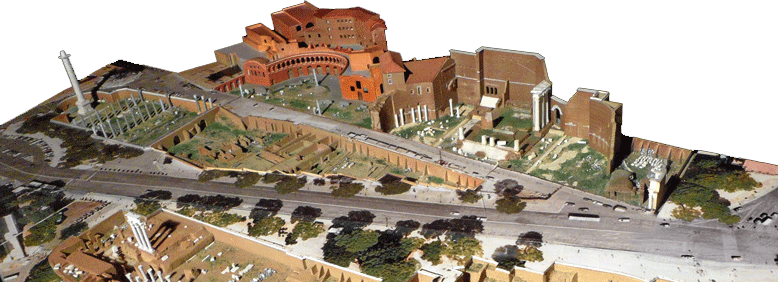
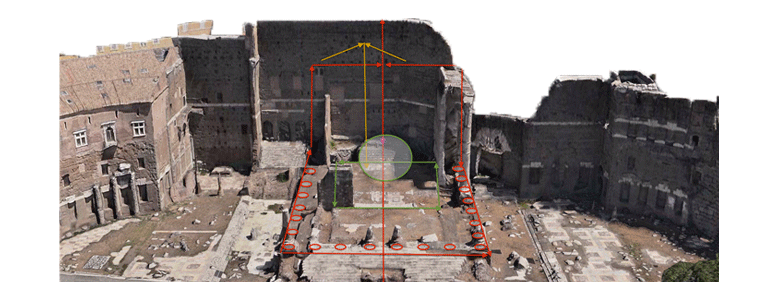
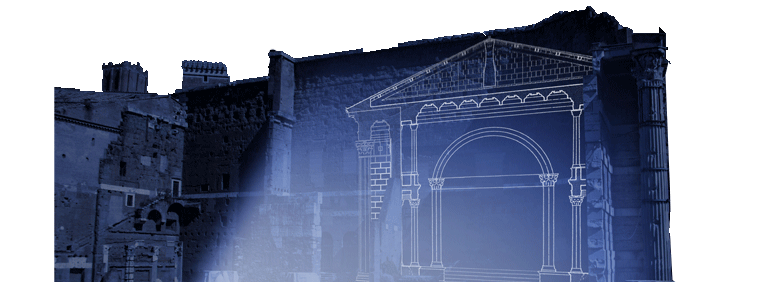
Il Foro di Augusto fu votato subito dopo l’uccisione di Giulio Cesare, nel 42 a.C., alla vigilia della battaglia di Filippi, che consentì a Ottavio, poi divenuto Augusto, di sconfiggere Bruto e Cassio, i due Cesaricidi. Il tempio fu dedicato a Marte Ultore cioè Marte il vendicatore, il dio della guerra e della forza che aveva permesso di riconquistare la pace. Il lavoro di Paco Lanciano e Piero Angela, di ricostruzione virtuale e visiva dell’elevato di questo foro e di tutto l’apparato decorativo, permette di avere una visione di come vivevano gli antichi all’interno di uno spazio pubblico di questo genere.
Claudio Parisi Presicce, Sovrintendente Capitolino ai Beni Culturali
THE PROJECT
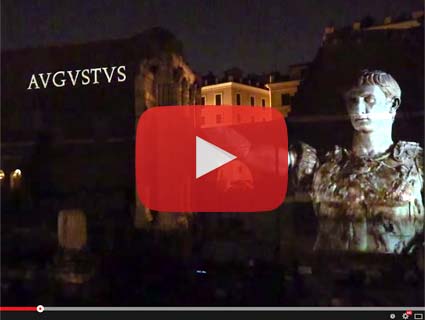
While spacing on various aspects of the Roman world, the story is still anchored to the site of Augustus, creatively using the remains of the Forum to try to let the stones “speak” for themselves. Besides the faithful reconstruction of the area, with special effects of all kinds, the story focuses on the figure of Augustus, whose giant statue, over 12 meters high, dominated the area next to the temple.
A new period of Roman history started under Augustus: as a matter of fact the imperial age was one of great achievement, within a century Rome ruled over an empire which extended from current England to the borders of the modern Iraq, including most of Europe, the Middle East and North Africa. These achievements led to the expansion not only of the empire, but also of culture, technologies, legal rules, art. Traces of that past are still visible in all parts of the Empire, with amphitheaters, baths, libraries, temples, roads.
Besides, after Augustus many other emperors left their mark in the Imperial Fora building their own Forum.
Rome at that time had more than one million inhabitants: no city in the world had ever had a population of those proportions; only London in the XIX century reached that size. It was the great metropolis of antiquity: the capital of economics, law, power and entertainment.

WHEN
From 17 April to 30 April: ore 20.20 – 21.20 – 22.20
(except 19 April for security reasons)
From 1 May to 31 August: ore 21.00 – 22.00 – 23.00
From 1 September to 30 September: ore 20.00 – 21.00 – 22.00
From 1 October to 3 November : ore 19.00 – 20.00 – 21.00
Duration: 40 minutes
HOW
 Through special audio systems with headphones the spectators will listen to music, special effects and the story narrated by Piero Angela in 8 languages (Italian, English, French, Russian, Spanish and Japanese, German and Chinese).
The spectators will be accompanied by the voice of Piero Angela and by some amazing videos and reconstructions that show places as they looked like at the time of Augustus: a thrilling representation which combines historical and scientific rigor with entertainment.